EdTech SaaS · Consumer Web
MBBS Planet
Making NEET medical-college counselling navigable for anxious families
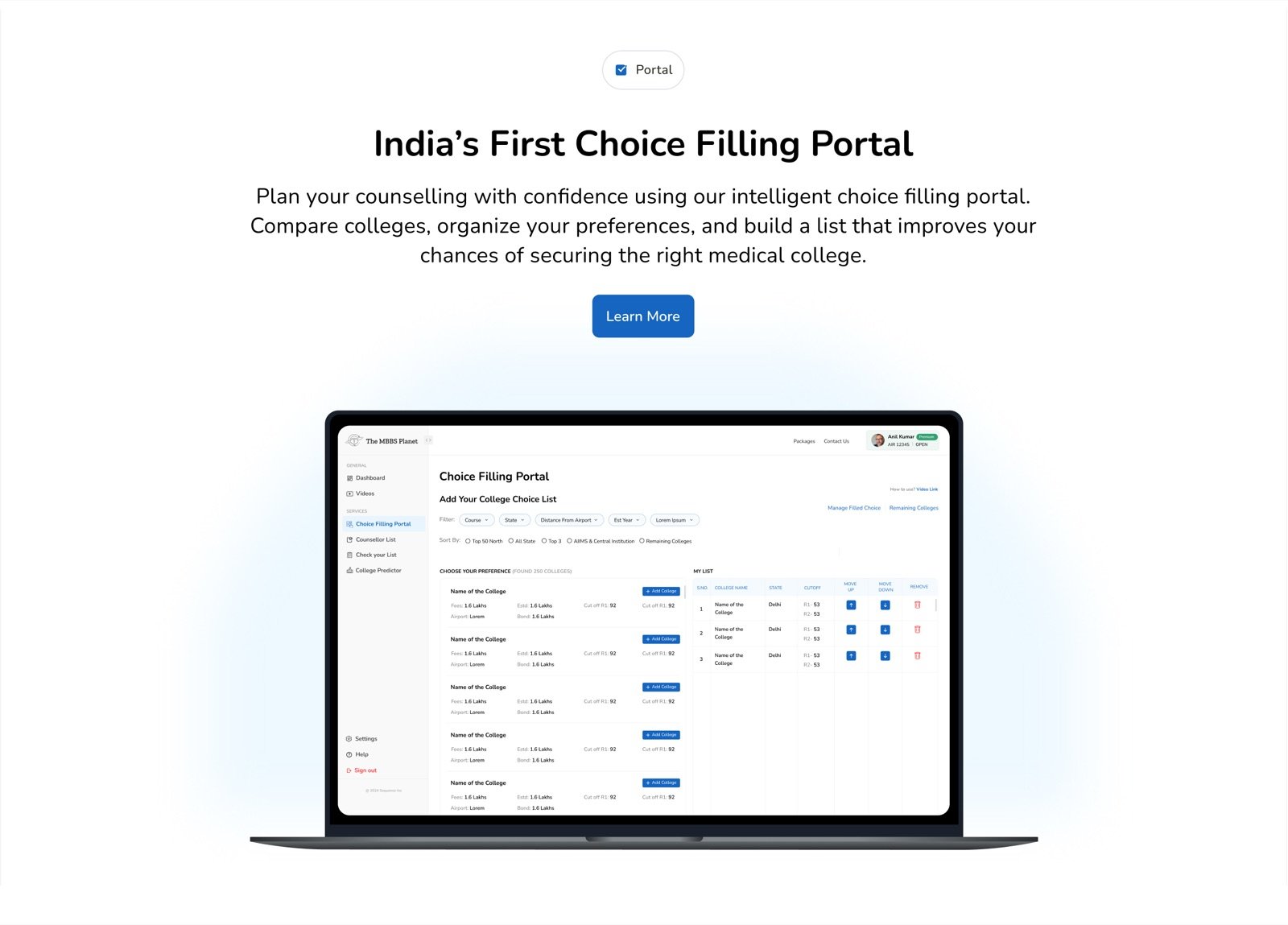
- Role
- Product Designer
- Team
- Founder · engineering team · counselling experts
- Timeline
- Freelance engagement · 2025
- Platforms
- Responsive Web, iOS, Android
- 0%
- Fewer UI inconsistencies
- 0+
- Users usability-tested
- 0
- Validation rounds
after the design-system rollout
across 2 moderated rounds
iterated until task-error rates fell
01 — Overview
The exam ends; the real anxiety begins
In India, clearing NEET is only half the battle. What follows is counselling: matching a rank against thousands of government and private medical colleges, each with its own quota, category cutoff, fee structure and bond conditions — across state and all-India rounds with deadlines measured in hours. Most families navigate this on WhatsApp forums, coaching hearsay and last-year PDFs.
MBBS Planet is the product I designed to replace that panic with a path: predict realistic colleges from a rank, understand each college honestly, and fill preferences with a system that actually models the rules.
The problem
A life-defining decision made under time pressure with scattered, untrustworthy data. Wrong choices mean a lost year or an unaffordable seat.
Business goals
Convert anxious visitors into paying counselling subscribers; establish MBBS Planet as the trusted first stop; reduce support load from repetitive 'am I eligible?' questions.
Constraints
Cutoff data is messy and changes yearly; users span first-generation aspirants to coaching-savvy repeaters; mobile-heavy audience on modest devices.

02 — Research
Sitting with families mid-counselling
I interviewed fourteen aspirants and parents actively in counselling, plus two professional counsellors, and studied the forums where the real questions get asked. The dominant emotion wasn't ambition — it was fear of a wrong click. Families weren't under-informed so much as drowning in conflicting information with no way to trust any of it.
Ananya
The aspirant
“My rank is 42,000. Just tell me which colleges I can actually get — not a list of 600 I'll never reach.”
- Realistic predictions
- Category clarity
- Deadline reminders
Mr. Verma
The paying parent
“It's ₹20 lakh over five years. I need to trust the number before I trust the college.”
- Honest fees
- Bond details
- Proof it's credible
Dr. Nair
The counsellor
“I answer the same eligibility question a hundred times a day. The tool should answer it once, correctly.”
- Accurate rule engine
- Shareable shortlists
- Fewer repetitive queries
Insight — 'realistic' beats 'complete'
A shorter list of attainable colleges built more confidence than an exhaustive directory. Coverage was making things worse.
Insight — trust is earned with specifics
Vague ranges read as marketing. Category-wise cutoffs, real fees and last-round data read as truth.
Insight — the deadline is the enemy
Most bad decisions traced back to time pressure, not lack of ambition. The product had to reduce panic, not add features.
03 — Design principles
From directory to decision companion
Predict, don't dump
Lead with a rank-and-category predictor that returns a realistic, ranked shortlist — not the whole database.
Radical honesty as a feature
Show real fees, bonds, category cutoffs and last-round closing ranks. Transparency is the moat in a category full of hype.
Model the rules, hide the machinery
Encode the messy counselling logic so users make choices in plain language while the system handles quotas and rounds.
Calm under a countdown
Every deadline-sensitive screen reduces cognitive load: one clear next action, reversible where possible.
04 — IA & flows
The path from rank to filled choices
Core counselling flow
- 1Enter rank + category
- 2Predicted college list
- 3Open college profile
- 4Add to preference list
- 5Order & fill choices
The information architecture reorganised everything around three surfaces: Predict (rank → realistic colleges), Explore (honest college profiles), and Fill (an ordered preference list mirroring the official choice-filling portal). The predictor became the front door; the directory became something you arrive at with intent, not something you drown in.
05 — Designing trust
The college profile that answers the real questions
The college profile is where trust is won or lost. I designed it to answer, in order, the questions families actually ask: Can I get in? What will it really cost? Is it any good? So the page leads with courses, category-wise fees and eligibility, then faculty, required documents, verified reviews and campus infrastructure — the exact sequence of a family's evaluation.
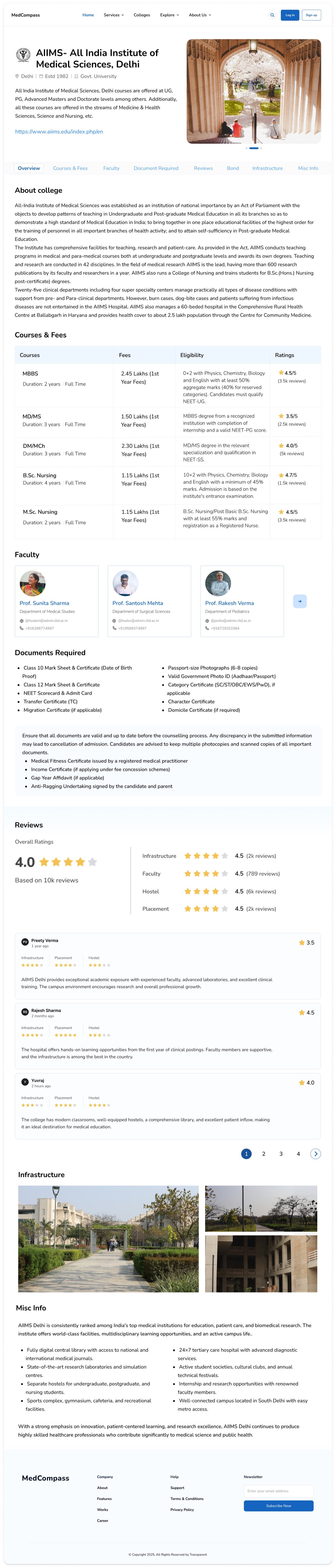
“This is the first place that told me the fees and the bond without making me call someone.”
06 — Design system
A calm system for high-stakes data
Data as first-class UI
Tables, cutoff cards and eligibility chips were designed as a component family with consistent rules for empty, estimated and verified data.
Confidence, encoded
Predictions carry an explicit confidence signal (safe / likely / reach) so a shortlist never over-promises.
Mobile-first density
Every dense table degrades gracefully to a scannable card stack on the phones most families actually use.
07 — Validation
Tested against the panic, not the demo
I ran two moderated rounds using real ranks from consenting participants, plus an unmoderated task test on the predictor. The benchmark task — 'from your rank, produce a shortlist of five colleges you'd actually fill' — went from an average of 14 anxious minutes on the old spreadsheet workflow to under 4 minutes in the prototype, with participants reporting markedly higher confidence in the result.
08 — Impact
Confidence, measured
- 0%
- Fewer inconsistencies
- 0
- Usability rounds
- 0%
- Handoff-ready
- 0
- Onboarding flow
screen-level, after the design system
10+ users, iterated to low task-error
token library + component docs
multi-step, web and mobile
09 — Reflection
What I'd carry forward
Honesty scales trust faster than features
Every time we showed a hard truth (a bond, a real fee), qualitative trust jumped. Restraint was the design decision that mattered most.
Design the rule engine with the experts
Pairing with counsellors on the eligibility logic saved us from beautiful screens that would have given wrong answers.
Next
Personalised deadline nudges timed to each aspirant's specific counselling round, not blanket reminders.
Want the full walkthrough — decisions, dead ends and all?