B2B Service Platform · Cultural Tourism
Ritualy
Turning India's weddings into the world's most personal travel experience
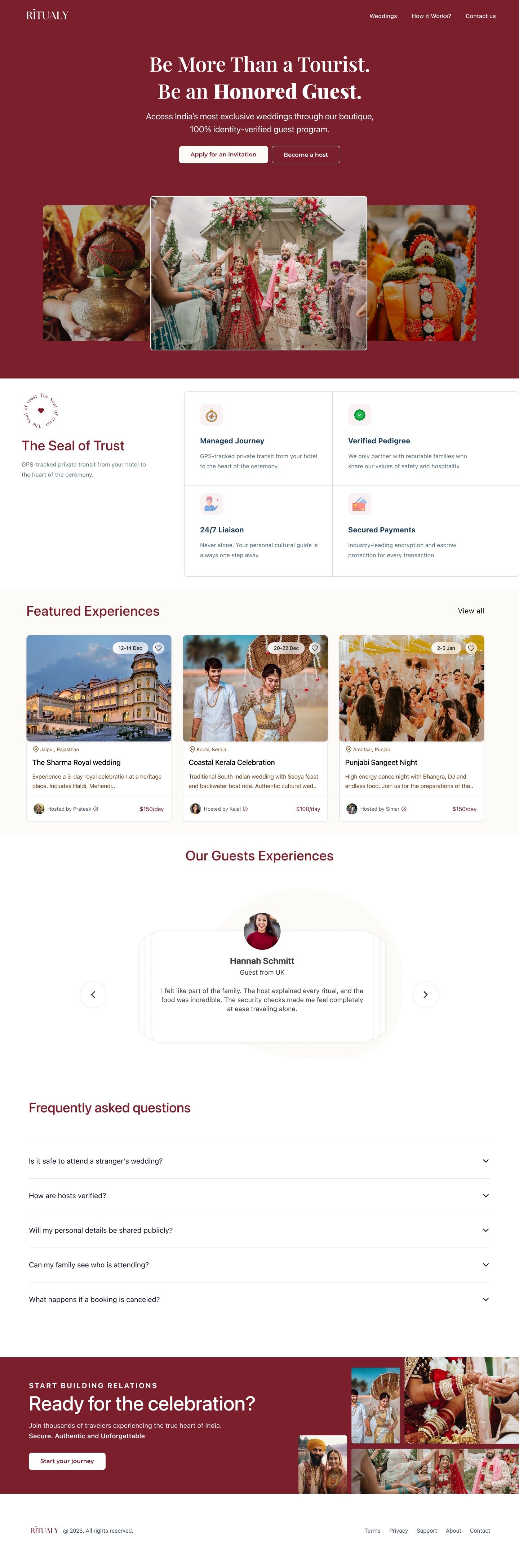
- Role
- Product Designer
- Team
- Founder · product · engineering
- Timeline
- Freelance engagement · 2025
- Platforms
- Responsive Web
- 0
- User journeys mapped
- 0
- Breakpoints designed
- 0
- End-to-end booking flow
tourists · cultural hosts · guides
full desktop and mobile experience
discovery through invitation request
01 — Overview
Be more than a tourist. Be an honoured guest.
A great Indian wedding is the most vivid cultural experience a traveller could have — and almost none of them ever get in. Ritualy connects identity-verified travellers with host families willing to welcome them into real ceremonies: sangeet, haldi, the wedding itself. The catch, and the entire design challenge, is trust. You are asking a family to invite a stranger to the most emotional day of their life, and a traveller to pay for access to something they can't preview.
I designed the product end to end, and the through-line of every decision was: make both sides feel safe enough to say yes.
The problem
A two-sided marketplace built on the hardest currency to earn online — trust between strangers around an intimate, non-refundable, once-only event.
Business goals
Grow verified guest bookings and quality host supply while keeping the experience premium, safe and unmistakably authentic — not voyeuristic.
Constraints
No inventory to preview (every wedding is unique and unrepeatable); guests and hosts from different cultures and expectations; safety and dignity are non-negotiable.
02 — Research
Two sides, one fear
I researched both sides of the marketplace: interviews with well-travelled cultural tourists and with Indian families who had hosted or would consider hosting. Both sides wanted the same thing and feared the same thing. Guests craved genuine belonging but feared being intrusive or scammed. Hosts felt proud to share their culture but feared disrespect, safety and awkwardness. Trust wasn't a feature request — it was the product.
Hannah
The cultural traveller
“I don't want a staged 'cultural show'. I want to actually be part of the family for a day.”
- Authenticity
- Clear etiquette
- Safety & refunds
The Sharma family
The host
“We'd love to share our daughter's wedding — but who is this person, and will they respect our rituals?”
- Vetted guests
- Control & dignity
- Secured payments
Priya
Solo woman traveller
“Before I pay, I need to know exactly who I'm meeting and that someone has my back.”
- Verified hosts
- 24/7 liaison
- Transparent details
Insight — sell belonging, not spectacle
The language and imagery had to promise participation and family, never a zoo-like 'watch a wedding' framing.
Insight — trust must be shown before the price
Guests wouldn't even consider a booking until verification, liaison and refund protection were visible and specific.
Insight — hosts need dignity and control
Supply grew only when families felt they retained control over who attends and how their rituals are represented.
03 — Design principles
Trust is the interface
The Seal of Trust, everywhere
Managed journey, verified pedigree, 24/7 liaison and secured payments appear as a consistent, first-class trust system — not fine print.
Honoured guest, never tourist
Every word and image frames the traveller as family-for-a-day. Dignity for hosts and guests is a design constraint, not a nicety.
Show the human before the transaction
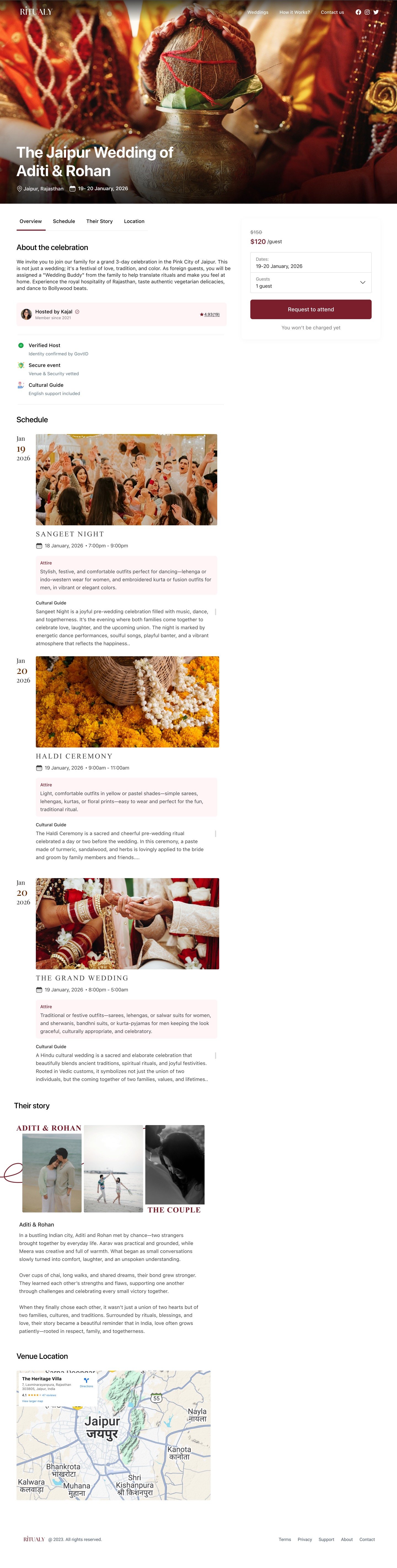
The couple's story, the schedule and the cultural guide come before the request-to-attend button.
Curated, not endless
A handful of exquisite, verified celebrations beats an infinite scroll. Scarcity signals quality and keeps supply premium.
04 — Discovery
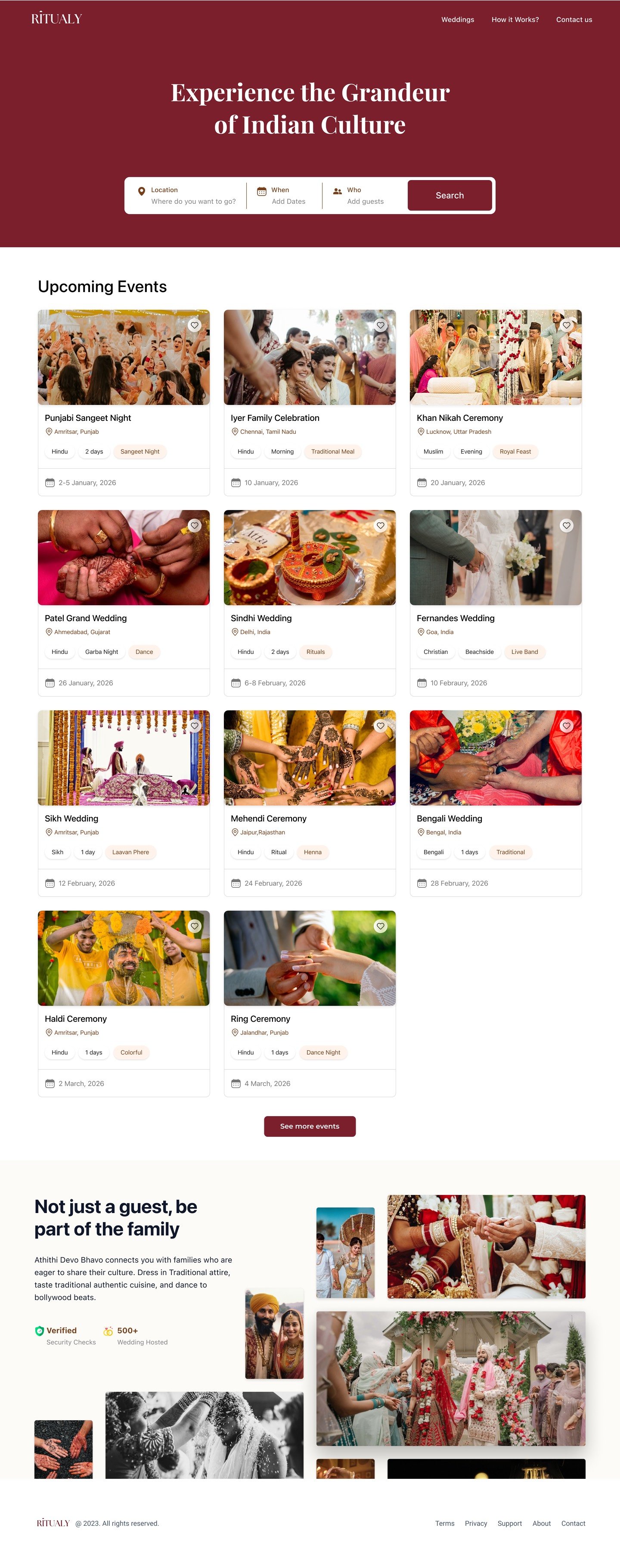
Browsing celebrations, not listings
Discovery had to feel like being invited to something rare, not scrolling a hotel site. I designed a search anchored on place, date and ritual, with event cards that lead with the human story and the ceremony type. Every card carries trust signals — verification, host rating — so credibility travels with the browse, not just the detail page.
05 — The wedding page
Where a stranger decides to say yes
The wedding page is the heart of the product. It sequences a traveller from curiosity to commitment: the celebration overview, a schedule of ceremonies with a cultural guide so guests know what to expect and how to behave, the couple's real story to make it human, the venue and location, and only then the request to attend. Verification and secured payment sit beside the booking so the leap of faith always has a safety net in view.
“By the time I reached the button, it didn't feel like buying a ticket — it felt like being invited.”
06 — Design system
Warmth held with discipline
A regal, warm palette
Deep celebratory maroons and golds signal occasion and premium, disciplined by generous neutral space so it never reads as a discount site.
Trust as a component family
Verification badges, host ratings, liaison and payment-protection modules were designed together so credibility looks identical everywhere it appears.
Editorial imagery rules
Photography guidelines centre real families and rituals with dignity — participation, never spectacle.
07 — Validation
Testing a leap of faith
Because you can't A/B-test a wedding, I focused on the decision to request an invitation. Across two prototype rounds with prospective guests, the redesigned trust-forward flow measurably raised stated willingness to book and, more tellingly, changed the language participants used — from 'a tour' to 'being invited'. Host-side concept tests confirmed that visible control and vetting were what moved families from 'maybe' to 'yes'.
08 — Impact
Strangers, ready to say yes
- 0
- User journeys
- 0
- Breakpoints
- 0
- Booking experience
- 0%
- Trust-first UI
tourists, cultural hosts, guides
desktop and mobile, end to end
discovery to invitation request
verification woven through every step
09 — Reflection
What this taught me
Trust is a system, not a badge
It only worked because verification, liaison, payments and language reinforced each other on every screen. One trust badge would have been noise.
Design for the person you're not selling to
The host's sense of dignity and control was as decisive as the guest's excitement. Two-sided means designing two fears away.
Next
A post-experience story layer so guests can share their day and become the most credible trust signal of all.
Want the full walkthrough — decisions, dead ends and all?